
A friend offered up his own interpretation of what Ed Glaeser and Boris Johnson's "objective" facts really mean.
London > New York? Let’s really be objective

A friend offered up his own interpretation of what Ed Glaeser and Boris Johnson's "objective" facts really mean.

A recent report by the Straphangers Campaign included a sobering figure: the MTA has a debt greater than the debt of 30 nations. But I wondered: what if we compared the MTA's debt to global GDPs. The answer is perhaps even more surprising.
John Adams's description of the New Yorkers he encountered on his way to the First Continental Congress is just as apt today as it was in 1774.

Washington, D.C., has grand plans for its grand transportation hub, Union Station. But will they get past financial and political hurdles? The Washington Post's Steven Pearlstein examines the plans and the obstacles in an extensive online piece.

Last Friday, The United States Conference of Mayors issued a major economic report on the contributions of urban areas to the national economy—and I got to play a small but important role in its release.

A trip to the post office last night showed me just how far we have to go toward accommodating all residents, of all ages and abilities, in the Greatest City in the World.
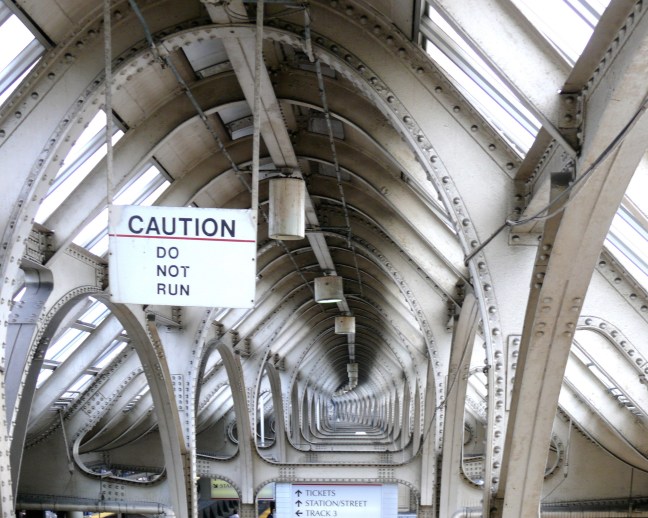
When I wanted to find out exactly how much of Greater New York's rail network I had ridden, I searched the internet for information on how big the network actually is—and discovered that no one seems to know. So I added it up. Myself. (And discovered that I've ridden 72% of it.)
As it turns out, I was about 10 miles off in my calculation of the total route miles covered by the New York City region's rail network.

I have a new (and, some would say, unsurprising) goal: to ride all 1,370 miles of passenger rail currently in service in the New York City region. That means the entire rail networks operated by the Metropolitan Transportation Authority, New Jersey Transit, and the Port Authority of New York and New Jersey.
The New York City Council is considering a bill that would require most stores to charge customers 10¢ per disposable bag in an effort to reduce the amount of waste the city produces.
 Dustin Tyler Joyce